Crypto Casino Login Guide: A Player's Guide to Account Security 2026
A secure gaming experience begins with a protected account, making a safe crypto casino login process a player's first line of defense. This informational guide provides essential, actionable steps for securing your account with tools like 2FA and password managers. Our website offers this security protocol to ensure every player can protect their digital assets effectively.
The Player's Security Protocol: Why a Secure Login is Non-Negotiable
Before you even enter your password, it's crucial to understand the landscape. A weak login process is an open invitation for malicious actors. For a player, the consequences are direct and severe: potential loss of funds, compromised personal information, and a loss of trust in the gaming environment. A secure login protocol, built on strong passwords and multi-layer verification, transforms your account from a soft target into a digital fortress. This isn't about paranoia; it's about control. By taking a few deliberate steps, you shift the power dynamic, making it exponentially more difficult for anyone but you to access your account. We will explore how these layers of security work together to protect your entire casino experience.
Understanding the Threats: What Are You Protecting Against?
For a crypto casino player, the primary threats are sophisticated and often target the weakest link: the user. Phishing attacks, where fraudulent websites or emails mimic legitimate casinos to steal credentials, are rampant. Brute-force attacks involve software rapidly guessing thousands of password combinations to gain entry. Finally, malware or spyware on a player's device can record keystrokes, capturing login details without their knowledge. Understanding these vectors is the first step in building an effective defense. A strong, unique password defends against brute-force attacks, while vigilance and knowledge are your best weapons against phishing.
The Role of the Casino: What a Reputable Platform Provides
While player vigilance is key, the casino itself has a fundamental responsibility to provide a secure framework. Reputable crypto casinos in 2026 invest heavily in security infrastructure. This starts with SSL (Secure Socket Layer) encryption—the padlock icon you see in your browser—which scrambles the data transmitted between your device and the casino's servers, making it unreadable to outsiders. They also implement account lockout policies after a certain number of failed login attempts and provide robust tools like 2FA. When choosing where to play, always verify the presence of SSL and review the casino's stated security policies. For more information on what differentiates top-tier platforms, our review of the Best Crypto Casinos 2026 provides a detailed security analysis.
A Step-by-Step Guide to a Secure Crypto Casino Login
Executing a secure login is a matter of habit. By following this simple, repeatable process every time you play, you drastically reduce your account's vulnerability. This process is designed for clarity and effectiveness, ensuring that every player, regardless of technical expertise, can protect their account effectively. From verifying the website's authenticity to using password managers, these steps form a comprehensive security ritual.
Step 1: Always Verify the URL. Before typing anything, double-check the website address in your browser. Look for the correct spelling of the casino name and the ".com" or other appropriate domain. Phishing sites often use subtle misspellings (e.g., "Betnlnja" instead of "Betninja") to trick users. Always use your own saved bookmarks or type the URL directly.
Step 2: Check for SSL Encryption. Confirm the presence of a padlock icon in the address bar and that the URL begins with "https://" not "http://". This confirms your connection is encrypted and secure. If it's missing, do not log in.
Step 3: Use a Password Manager. Instead of manually typing your password, use a reputable password manager (like Bitwarden or 1Password). This automates the process of using long, complex, unique passwords for every site and protects you from keylogging malware following OWASP (Open Web Application Security Project) best practices. It also helps prevent you from accidentally entering your password on a phishing site, as the manager won't recognize the fraudulent URL.
Step 4: Enter Your 2FA Code Promptly. When prompted for your Two-Factor Authentication code, retrieve it from your authenticator app and enter it. These codes are time-sensitive, usually expiring every 30-60 seconds, adding a crucial layer of real-time security.
Step 5: Log Out After Your Session. Especially on shared or public computers, always actively log out of your account when you are finished playing. This prevents unauthorized access by the next person to use the device.
By integrating these five steps into your routine, you create multiple barriers to unauthorized access. This disciplined approach ensures that even if one layer of your security is compromised—for instance, if your password is stolen—the subsequent layers, like 2FA, will keep your account safe.
Activating Your Digital Fortress: A Player's Guide to 2FA
Two-Factor Authentication (2FA) is arguably the single most impactful security feature a player can enable. It adds a second layer of verification to the login process, requiring something you have (your phone) in addition to something you know (your password). Even if a thief steals your password, they cannot access your account without physical access to your device. For players managing crypto assets, enabling 2FA is not optional; it is essential. Most reputable casinos like Instaspin and Let's Jackpot actively encourage and simplify the 2FA setup process.
SMS vs. Authenticator App: Which is Safer for You?
You will typically be offered two 2FA options: codes sent via SMS or codes generated by an authenticator app like Google Authenticator or Authy (which offers enhanced cloud backup functionality). While SMS is convenient, it is vulnerable to "SIM swapping"—a scam where a hacker hijacks your phone number to intercept the codes. For this reason, an authenticator app is profoundly more secure. It generates codes directly on your device, independent of your phone number, making it immune to this attack vector. For any account securing crypto assets, using an authenticator app is the only correct choice.
How to Set Up an Authenticator App (Example: Google Authenticator)
Setting up an app-based 2FA is a straightforward, one-time process that provides lasting security. In your casino's account security settings, select the option to enable 2FA using an authenticator app. The site will display a QR code. Open your authenticator app, tap the '+' icon to add a new account, and scan the QR code with your phone's camera. The app will then begin generating 6-digit codes that refresh every 30 seconds. The casino will ask you to enter the current code to verify the link. Finally, be sure to save the backup recovery codes provided by the casino in a secure offline location. These codes are your only way to regain access if you lose your phone.
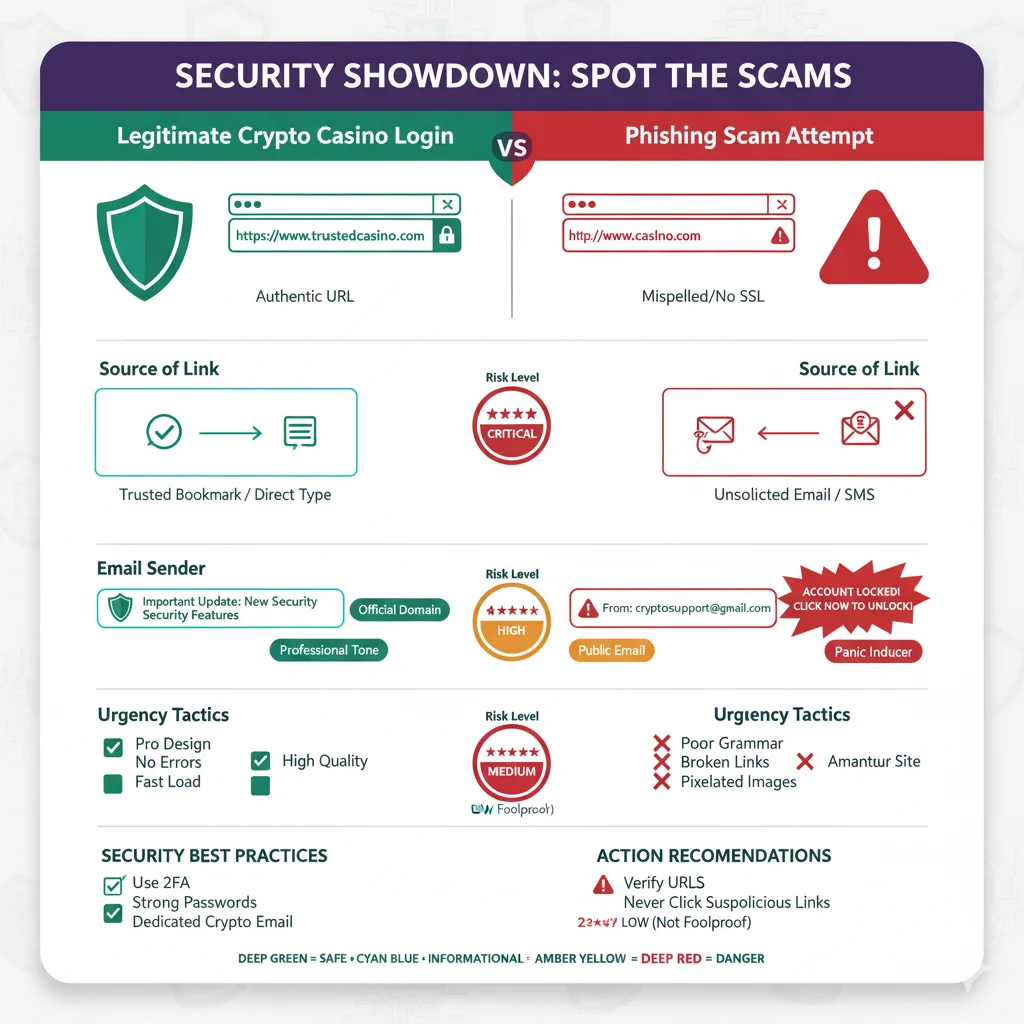
Phishing Scams vs. Legitimate Logins: A Comparative Analysis
For a player, the ability to distinguish a genuine casino login page from a fraudulent phishing attempt is a critical skill. Scammers are experts at creating convincing fakes to steal your credentials. The following table breaks down the key differences, providing you with a clear checklist to consult if you ever feel uncertain about a login page. Understanding these red flags is your primary defense against the most common type of account theft in the online world.
Characteristic
Legitimate Crypto Casino Login
Phishing Scam Attempt
Player Action Required
Security Impact
URL Structure
Correctly spelled, starts with https://, shows a padlock icon.
Subtle misspellings, uses http://, or has a long, strange subdomain.
Always double-check the address bar before entering any data.
High. A fake URL is the most definitive sign of a scam.
Source of Link
Accessed via a trusted bookmark or by typing the URL directly.
Clicked from an unsolicited email, SMS, or social media message.
Never click login links from unexpected emails. Go to the site directly.
High. Unsolicited links are a primary vector for phishing.
Email Sender
Comes from the official casino domain (e.g., support@betninja.com).
Uses a public email service (e.g., casino.support@gmail.com) or a misspelled domain.
Inspect the sender's full email address, not just the display name.
Medium. A fake sender address is a strong indicator of a scam.
Sense of Urgency
Communications are professional and informative.
Emails create panic, e.g., "Your account is locked, click here to verify!"
Be suspicious of any message demanding immediate action.
Medium. Scammers use urgency to make you bypass security checks.
Website Quality
High-quality design, no typos or grammatical errors. All links work.
Poor grammar, blurry images, or links that don't work or lead to the same fake page.
Look for signs of unprofessionalism on the site.
Low. Some phishing sites are very well-made, so this is not a foolproof check.
Ultimately, the best defense is a healthy sense of skepticism. Legitimate casinos will never ask for your password via email. They will never pressure you with urgent threats to your account's safety via a clickable link. If you receive such a communication, the safest course of action is to ignore it, delete it, and log in to your account through a trusted, independent method like a bookmark to verify your account status directly on the official site.
Advanced Security Habits for the Strategic Player
Beyond the fundamentals of passwords and 2FA, strategic players can adopt several advanced habits to further harden their account security. These practices are about creating a secure ecosystem around your gaming activity, minimizing your digital footprint and reducing potential attack vectors. While not strictly necessary for casual play, these habits are highly recommended for high rollers or any player who maintains a significant balance in their casino account.
Using a Dedicated Browser or Device
For maximum security, consider using a separate web browser exclusively for your online casino activities. This browser should have minimal extensions and a clean history, reducing the risk of malicious add-ons compromising your data. Some high-stakes players even use a dedicated device—a laptop or tablet—that is used for nothing but accessing their casino and crypto exchange accounts. This compartmentalization ensures that a security issue on your primary device (from general browsing or downloads) cannot spill over and affect your gaming assets.
The Importance of VPNs for Privacy
A Virtual Private Network (VPN) encrypts your internet traffic and masks your IP address, providing a significant boost to your privacy. While not a direct defense against a compromised password, a VPN prevents your Internet Service Provider (ISP) and other entities on a public Wi-Fi network from seeing that you are connecting to a gambling site. This is particularly important for players who value discretion. Many privacy-focused platforms, often discussed in guides to No KYC Crypto Casinos, are VPN-friendly, allowing players to add another layer of anonymity to their activity.
Security Best Practices: A Quick Reference
Maintaining strong account security is an ongoing process, not a one-time setup. The following checklist summarizes the key best practices that every crypto casino player should adopt. Refer to this list periodically to ensure your security habits remain sharp and effective. These actions are simple, yet they provide a powerful defense against the most common security threats players face.
Security Practice
Player Benefit
How Often?
Recommended Tool/Method
Player Type Focus
Use Unique Passwords
Prevents a breach on one site from compromising your casino account.
Always (for every online account).
Password Manager (Bitwarden, 1Password).
All Players
Enable App-Based 2FA
Protects your account even if your password is stolen.
One-time setup per casino.
Authenticator App (Google Authenticator, Authy).
All Players (Essential)
Review Login History
Allows you to spot unauthorized access attempts quickly.
Weekly or monthly.
Check the 'Security' or 'Login History' tab in your account settings.
Strategic & Security-Conscious
Use a VPN
Enhances privacy by masking your IP address and encrypting traffic.
Every session.
Reputable VPN Service (e.g., NordVPN, ProtonVPN).
Security-Conscious & High Rollers
Avoid Public Wi-Fi
Reduces the risk of "man-in-the-middle" attacks on unsecured networks.
Always.
Use your mobile data plan instead of public hotspots if possible.
All Players
Verify URLs Before Login
Your primary defense against phishing scams.
Every login.
Use bookmarks or type the URL directly into the browser.
All Players (Essential)
By internalizing these practices, you move from being a potential target to a well-defended player. This proactive approach to security not only protects your funds but also provides the peace of mind needed to fully enjoy the gaming experience. Security and entertainment are two sides of the same coin in the world of online crypto casinos; one cannot fully exist without the other.
What to Do if You Suspect a Security Breach
Even with the best precautions, there may come a time when you suspect your account has been compromised. Swift and decisive action is critical to mitigating potential damage. If you notice suspicious activity, such as logins from unrecognized locations in your account history, or if you realize you may have entered your details on a phishing site, follow these steps immediately. Do not panic; a methodical response is your best course of action.
Step 1: Immediately Change Your Password
Your first priority is to lock out the unauthorized user. Log in to your casino account (from a trusted device) and change your password immediately. Choose a new, strong, and unique password that you have never used before. If you cannot log in, use the casino's "Forgot Password" feature to initiate a reset via your registered email. At the same time, it is wise to change the password for that email account as well, in case it has also been compromised.
Step 2: Contact Casino Support
Simultaneously, contact the casino's customer support team through their official channels (live chat or a support email found on their website). Inform them that you suspect a security breach. They can take immediate action, such as temporarily freezing your account and any pending withdrawals, to prevent financial loss. Provide them with as much detail as possible, including the time of the suspected breach and the nature of the suspicious activity.
Step 3: Review and Secure Linked Accounts
After securing your casino account, consider any other accounts that might be linked. If you use the same password on other sites (a practice you should avoid), change them immediately. Check your crypto exchange and personal wallet transaction histories for any unauthorized activity. This comprehensive review ensures the breach is contained and does not spread to other areas of your digital financial life.
Protecting Your Crypto Casino Assets: Advanced Security Measures
Securing your crypto casino account requires treating it with the same rigor as your cryptocurrency exchange or hardware wallet—because the assets at stake are equally real. Beyond basic 2FA, implement a comprehensive security stack. Use a hardware security key (YubiKey) for authentication where supported; this physical device is immune to phishing and remote attacks. Create a dedicated, high-security email address for your casino accounts using an encrypted provider like ProtonMail, and enable 2FA on that email account as well—your email is often the recovery vector for account access. Employ a reputable password manager (Bitwarden, 1Password) to generate and store unique, complex passwords for each casino; password reuse across sites is one of the most common attack vectors. Regularly review your account's login history and active sessions, immediately revoking any unfamiliar access. For high-value accounts, consider using a dedicated device or at minimum a separate browser profile that's used exclusively for gambling and financial activities. Enable withdrawal address whitelisting if available, which requires additional verification to send funds to new addresses. This defence-in-depth approach ensures that compromising your account would require breaching multiple independent security layers—a significantly higher bar than most attackers are willing to clear.
F.A.Q
The most secure method involves a multi-layered approach: always verify the site's URL starts with https://, use a unique and complex password generated by a password manager, and enable app-based Two-Factor Authentication (2FA) using an app like Google Authenticator. This combination makes unauthorized access extremely difficult.
While convenient, saving your password directly in your browser is less secure than using a dedicated password manager. Browsers can be targeted by malware that steals saved credentials. A standalone, encrypted password manager provides a much higher level of security for protecting your casino login details.
Check for red flags: the sender's email address doesn't match the official casino domain, the email creates a false sense of urgency (e.g., 'account suspended'), it contains spelling errors, and it asks you to click a link to verify your details. Legitimate casinos will never ask for your password via email.
When you first set up 2FA, the casino provides you with a set of one-time backup codes. You must save these in a secure, offline location. These codes are your key to regaining access to your account and setting up 2FA on a new device. If you lose your codes, you will have to go through a lengthy identity verification process with casino support.
A VPN primarily protects your privacy by encrypting your internet connection and masking your location; it does not directly prevent your account from being hacked. It won't stop a hacker who already has your password. However, it provides crucial security on public Wi-Fi and adds a layer of anonymity, which are important components of a comprehensive security strategy.